
The Background and Intent of the 14th Amendment
The 14th Amendment, ratified in 1868, was primarily designed to secure equal protection under the law and to define the rights of citizenship. Its framers aimed to address the post-Civil War repercussions and establish a framework for uniform rights and protections for all citizens, irrespective of their racial or ethnic backgrounds. At its inception, this amendment had not foreseen any direct implications for presidential eligibility.
The Emoluments Clause: A Historical Perspective
One critical aspect that has garnered attention in recent years is the Emoluments Clause, found within the Constitution. This clause prohibits federal officeholders from receiving gifts, titles, or any form of benefit from foreign states or their representatives without the consent of Congress. The framers of the Constitution included this clause as a safeguard against potential conflicts of interest for public officials.
It’s worth noting that the Emoluments Clause has been a subject of debate and scrutiny in recent times. During Donald Trump’s presidency, allegations were raised that his financial dealings with foreign entities might have contravened this clause. Although the Emoluments Clause has rarely been litigated in the past, the controversies surrounding it during the Trump administration did bring it into the spotlight.
The use of the Emoluments Clause gained attention during President George Washington’s tenure when he accepted gifts from foreign governments. However, it was not until the Trump presidency that the clause faced extensive legal scrutiny.
Presidential Pardon Power: A Complex Web
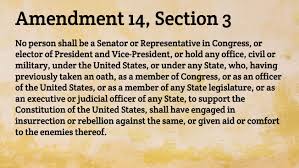
Now, let us delve into Section 3 of the 14th Amendment, which adds layers of complexity to this discussion. This section asserts that individuals who have engaged in insurrection or rebellion against the United States shall be disqualified from holding office. In light of the events of January 6th at the Capitol, some have argued that Trump’s actions may fall within the purview of this insurrection clause. However, an intriguing twist arises with the potential use of the presidential pardon power.
The presidential pardon power, vested in the President by Article II, Section 2 of the Constitution, allows the Chief Executive to pardon individuals for federal crimes. This has led to a contentious debate regarding whether Trump, or any President, could issue a self-pardon.

The self-pardon question is a legal conundrum that remains unresolved. Some legal scholars argue that a President’s power to pardon is broad, but others contend that the concept of a self-pardon is inconsistent with the fundamental principle that no one should be a judge in their own case.
The notion of self-pardoning has never been tested in a court of law. No President has attempted to pardon themselves, leaving this constitutional question without a definitive answer.
Interpretational Challenges and Legal Precedents
The interpretation of constitutional provisions often relies on legal precedents. In the 1803 case of Marbury v. Madison, the Supreme Court established its authority to determine the constitutionality of laws. Any analysis of the 14th Amendment’s applicability to Trump’s future candidacy must consider proper judicial review and the potential involvement of the nation’s highest court.

Public Interpretation and Political Ramifications
The 14th Amendment’s applicability to Donald Trump has far-reaching political ramifications. Public opinion on the matter differs, reflecting the current political climate and ideological divisions. Convincing arguments can be made on both sides, depending on one’s perspective and interpretation of the Constitution.
While the 14th Amendment to the US Constitution serves as the backbone of equal protection under the law, determining its direct applicability to the 2024 election and Donald Trump presents a complex challenge. The interplay of the Emoluments Clause, the insurrection clause, interpretational nuances, and political implications makes this a multifaceted topic. As the nation grapples with the broader implications of presidential eligibility, it is essential to engage in meaningful dialogue, backed by evidence and legal analysis, to reach an informed conclusion.
In the grand theater of American politics, the 14th Amendment is like the unexpected plot twist that keeps us all on the edge of our seats, wondering what will happen next. Stay tuned for the next episode of “jtwb768 Babbles About The Donald!”

